

Blog
Is Your Paddle “Dead”? How to Spot Delamination and Core Crush

Have you ever picked up your paddle and thought, “Something feels off”?
The sound is dull. The ball doesn’t come off the face like it used to. Your shots feel inconsistent—even though your technique hasn’t changed.
Chances are, your paddle may be “dead.”
In pickleball, two of the most common reasons for a paddle losing performance are delamination and core crush. Understanding what they are—and how to spot them—can save you frustration and help you know when it’s time to replace your paddle.
What Does a “Dead” Paddle Mean?
A dead paddle isn’t broken in half. It still looks fine on the outside—but internally, it no longer performs as designed.
Typical symptoms include:
- Loss of pop or responsiveness
- Inconsistent ball speed
- A muted or hollow sound at impact
- Reduced control or unpredictable rebound
Most of the time, these issues come from internal structural failure, not surface wear.
1. Delamination: When Layers Separate
What Is Delamination?
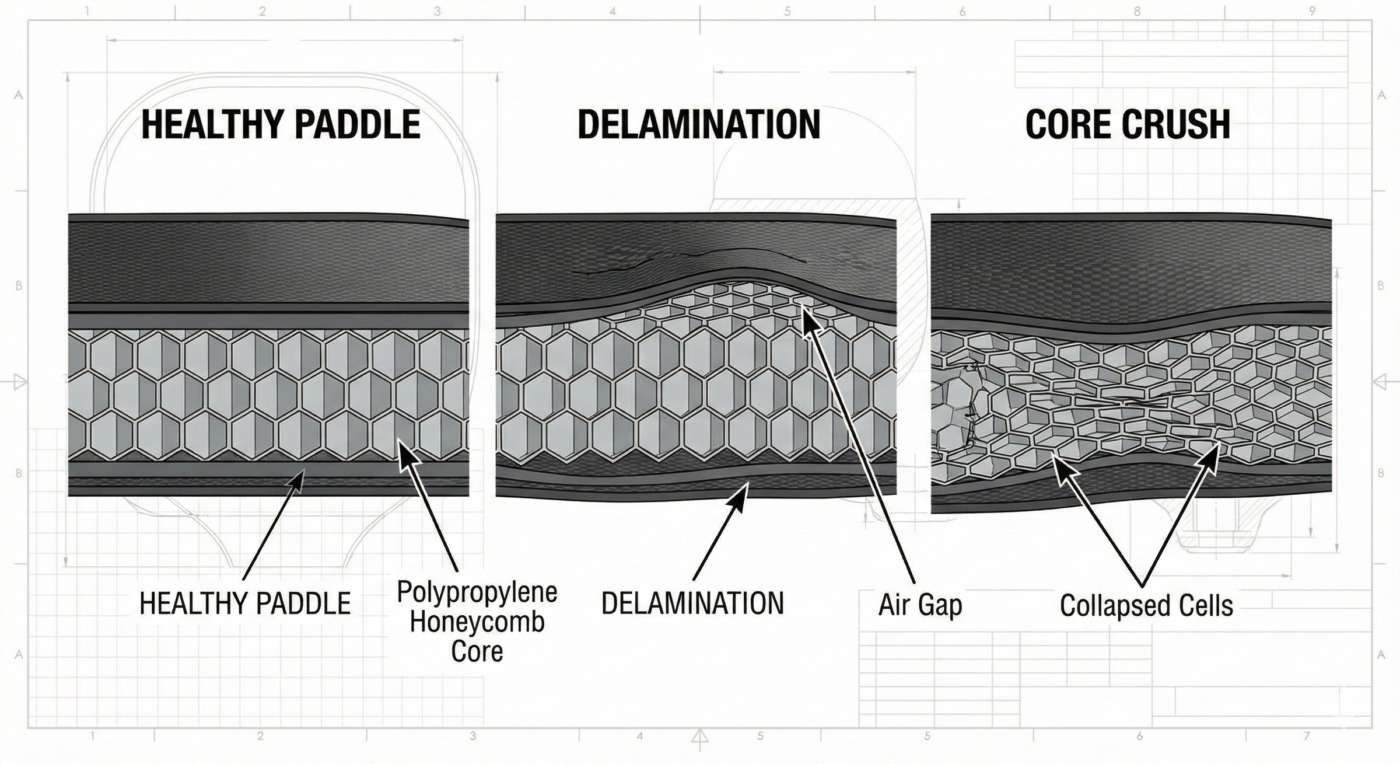
Delamination happens when the layers of the paddle separate internally. In most paddles, this means the face material (carbon fiber, Kevlar, etc.) begins to detach from the core.
This separation creates air gaps, changing how energy is transferred to the ball.
Common Causes
- Repeated high-impact shots (drives, smashes, speed-ups)
- Extreme heat or cold exposure
- Manufacturing defects or poor bonding
- Long-term heavy use
How to Spot Delamination
- Unusual sound: A hollow, echo-like “thud” instead of a crisp pop
- Hot spots: Certain areas suddenly feel much more powerful than others
- Inconsistent rebound: Same swing, different ball speeds
- Failed press test: Gently press the face—if it feels spongy or uneven, that’s a red flag
⚠️ Important:
Delaminated paddles can exceed legal rebound limits and may be considered illegal for tournament play.
2. Core Crush: When the Core Collapses
What Is Core Crush?
Core crush occurs when the internal honeycomb core permanently deforms. The tiny cells inside the core collapse under repeated stress and no longer recover their original shape.
Unlike delamination, core crush usually develops gradually.
Common Causes
- Extended use over time
- High swing speeds
- Repeated off-center hits
- Thin paddles subjected to heavy power play
How to Spot Core Crush
- Loss of pop: The paddle feels flat or “soft”
- Reduced power: You have to swing harder for the same result
- Muted feel: Less feedback through the handle
- Uniform dead zones: Not just one spot—large areas feel lifeless
Core crush usually won’t create hot spots. Instead, the paddle just feels… tired.
Delamination vs. Core Crush: Quick Comparison
| Feature | Delamination | Core Crush |
|---|---|---|
| What fails | Bond between layers | Internal honeycomb structure |
| Effect on power | Sudden increase or inconsistency | Gradual loss of power |
| Sound | Hollow or echo-like | Dull and muted |
| Risk of illegality | High | Low |
| Progression | Can happen suddenly | Develops over time |
Why Modern Paddles Are More Susceptible
As paddle technology advances—especially with thermoformed builds and high-energy designs—performance increases, but so does internal stress.
Higher rebound potential, thinner faces, and stronger materials mean:
- More force is transferred into the core
- Bonding quality becomes critical
- Material fatigue happens faster if not engineered correctly
That’s why internal testing (deflection control, rebound management, bonding integrity) matters just as much as surface materials.
How to Extend the Life of Your Paddle
You can’t prevent wear forever—but you can slow it down:
- Avoid leaving paddles in hot cars
- Use a protective cover
- Rotate paddles if you play frequently
- Avoid repeated edge slams
- Don’t use a paddle past its performance peak
Most competitive paddles have a performance lifespan, not just a physical one.
When Should You Replace a Paddle?
If you notice:
- Persistent inconsistency
- Clear dead or hot zones
- A sound change you can’t ignore
- Performance drop despite good technique
…it’s likely time.
A fresh paddle doesn’t just restore power—it restores confidence.
Final Thoughts
A “dead” paddle doesn’t mean you’ve done anything wrong. It means you’ve used it.
Delamination and core crush are signs of a paddle that’s given you everything it has. Knowing how to recognize them helps you stay competitive, safe, and confident on the court.
Because in pickleball, your paddle should never be the weakest part of your game.

 Canada
 USA
USA Japan
Japan